Key Findings
QuickFAQs
In local government, the most powerful offices are often the least visible. Drain commissioners control millions of dollars in infrastructure spending, engineering contracts, and long-term environmental projects, yet the office rarely attracts sustained public scrutiny.
In Eaton County, that dynamic may be shifting.
Multiple county officials have raised concerns about the conduct and visibility of Eaton County Drain Commissioner Richard Wagner, including questions about his attendance at public meetings and his campaign finance relationships with engineering firms working on county drainage projects. Wagner is also the father of former Michigan DOC officer Casey Wagner and carries connections to Representative Gina Johnsen.
Concerns From Within County Government
According to the official, Wagner has frequently declined to attend township meetings where residents expected direct answers about drainage issues affecting their communities. At one recent meeting, a deputy appeared in his place.
“People weren’t mad at the deputy. They were frustrated that the person elected to the office didn’t show up.”
The official also described Wagner as largely inaccessible since taking office.
“I’ve been a county commissioner since January 2025 and I’ve seen him once. As soon as he finished speaking, he left the room and didn’t stay to talk to anyone.”
Campaign Finance Questions
Beyond the attendance concerns, some county officials are questioning Wagner’s campaign finance relationships. Public filings reviewed by Clutch Justice show contributions from engineering firms with ties to regional drainage work. One firm appearing in both campaign records and regional drainage planning materials is Spicer Group, which is referenced in documents related to the Bank Intercounty Drain project.
The official put it plainly:
“Is it illegal? No. But it doesn’t look good when the firms involved in projects are also campaign supporters.”
A Powerful Office With Limited Oversight
The Drain Commissioner’s office operates with significant independence from county board authority. Unlike most county departments, the Drain Commissioner is an independently elected official regulated primarily by state statute rather than local governance structures. That structure leaves county commissioners with limited tools for addressing concerns about transparency or responsiveness.
The official described the practical consequence:
“Fifteen of us have to answer to our constituents. But the drain commissioner is the highest-paid elected official in the county and we have no authority over the office.”
Note: The claim about compensation ranking reflects the official’s characterization, not independently verified payroll data.
Public Frustration Growing
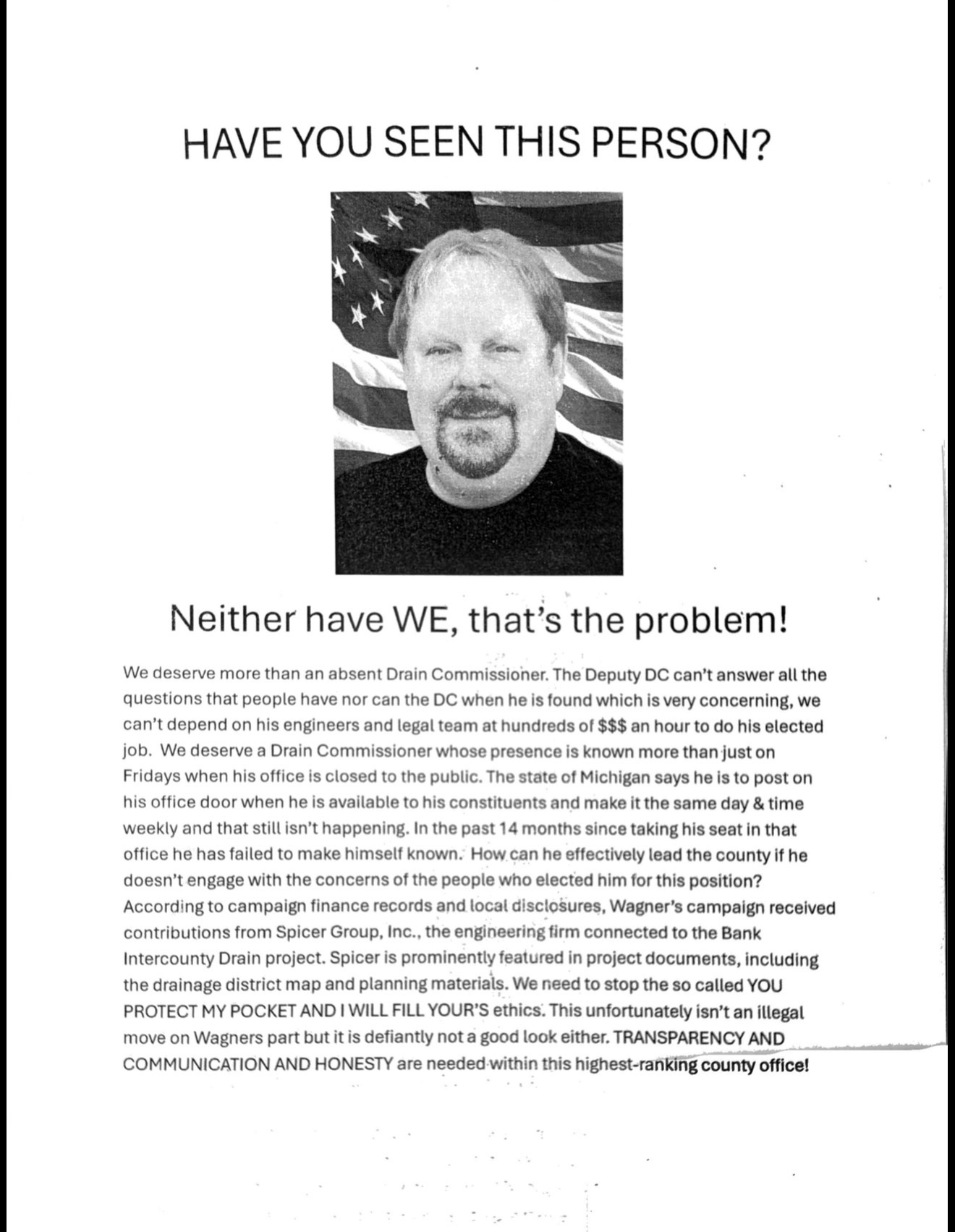
Residents in the county have distributed flyers criticizing Wagner’s limited public presence and calling for greater transparency from the office. One flyer, shared with Clutch Justice by a county official, asks: “Have you seen this person?”

Drain commissioners play a critical role in managing flooding, drainage infrastructure, and environmental projects, particularly in rural counties where water management decisions can directly affect farmland, roads, and residential property.
Why This Case Matters
Drain commissioners control some of the most technically complex and financially significant infrastructure decisions in county government. Their choices shape engineering contracts, environmental planning, and property assessments over years, often without meaningful public visibility.
Because the office operates with limited day-to-day oversight from county boards, public engagement and transparency become the primary checks on how that authority is used. When questions about campaign finance relationships and accessibility go unaddressed, the accountability gap that exists structurally in the office’s design becomes a practical governance problem.
Whether the concerns raised by Eaton County officials lead to formal scrutiny of the office remains to be seen. The pattern they describe, a powerful independently elected official with limited oversight and documented campaign ties to contractors, is not unique to Eaton County. It is a structural feature of how Michigan drain commissioner offices are designed to operate.
Sources
How to Cite This Article
Rita Williams, Eaton County Officials Raise Concerns About Drain Commissioner Richard Wagner’s Absence and Campaign Ties, Clutch Justice (Mar. 13, 2026), https://clutchjustice.com/2026/03/13/eaton-county-drain-commissioner-richard-wagner-absence-campaign-finance/.
Williams, R. (2026, March 13). Eaton County officials raise concerns about Drain Commissioner Richard Wagner’s absence and campaign ties. Clutch Justice. https://clutchjustice.com/2026/03/13/eaton-county-drain-commissioner-richard-wagner-absence-campaign-finance/
Williams, Rita. “Eaton County Officials Raise Concerns About Drain Commissioner Richard Wagner’s Absence and Campaign Ties.” Clutch Justice, 13 Mar. 2026, clutchjustice.com/2026/03/13/eaton-county-drain-commissioner-richard-wagner-absence-campaign-finance/.
Williams, Rita. “Eaton County Officials Raise Concerns About Drain Commissioner Richard Wagner’s Absence and Campaign Ties.” Clutch Justice, March 13, 2026. https://clutchjustice.com/2026/03/13/eaton-county-drain-commissioner-richard-wagner-absence-campaign-finance/.


Something went wrong. Please refresh the page and/or try again.